Headless Commerce & AI Personalization: Scaling a D2C Brand from $250k to $2.2M Annual Revenue
How we migrated a bottlenecked Shopify store to a custom headless commerce platform, deployed a real-time AI recommendation engine, and achieved a 3.2x conversion rate lift — all with zero downtime during the transition.

The Operational Reality: When Shopify Becomes the Bottleneck
Our client, a fast-growing D2C brand in the personal care space, had built a strong presence on social media and was generating $250k in annual revenue through a standard Shopify store. But as order volume scaled past 5,000 daily transactions, everything started breaking.
Page load times had ballooned to 4.2 seconds — well above the 2-second threshold where 53% of mobile users abandon a site. Their product catalog of 8,000+ SKUs was sluggish to search, impossible to personalize, and inventory sync between their warehouse management system and Shopify was manual, leading to frequent overselling and customer complaints.
They did not need a redesign. They needed a complete re-architecture of their commerce infrastructure — one that could handle 10x their current load while actually improving the buying experience.
The Challenges
- Performance Bottleneck: 4.2-second page loads on mobile were killing conversion rates. Shopify's liquid templating engine could not deliver the sub-200ms experience their competitors were offering with custom storefronts.
- Zero Personalization: Every customer saw the same product grid regardless of browsing history, purchase patterns, or demographics. This resulted in a below-average 1.8% conversion rate on a catalog of 8,000+ SKUs.
- Manual Inventory Chaos: Warehouse inventory was synced to Shopify via CSV uploads twice daily. During flash sales, this delay caused overselling, order cancellations, and significant brand damage on social media.
- Per-Transaction Fee Drain: Shopify's 2% transaction fee on a non-Shopify payment gateway was eroding margins on a high-volume, low-margin D2C model. At $250k revenue, this translated to $5,000+ lost annually.
The Solution: Headless Commerce + AI Personalization
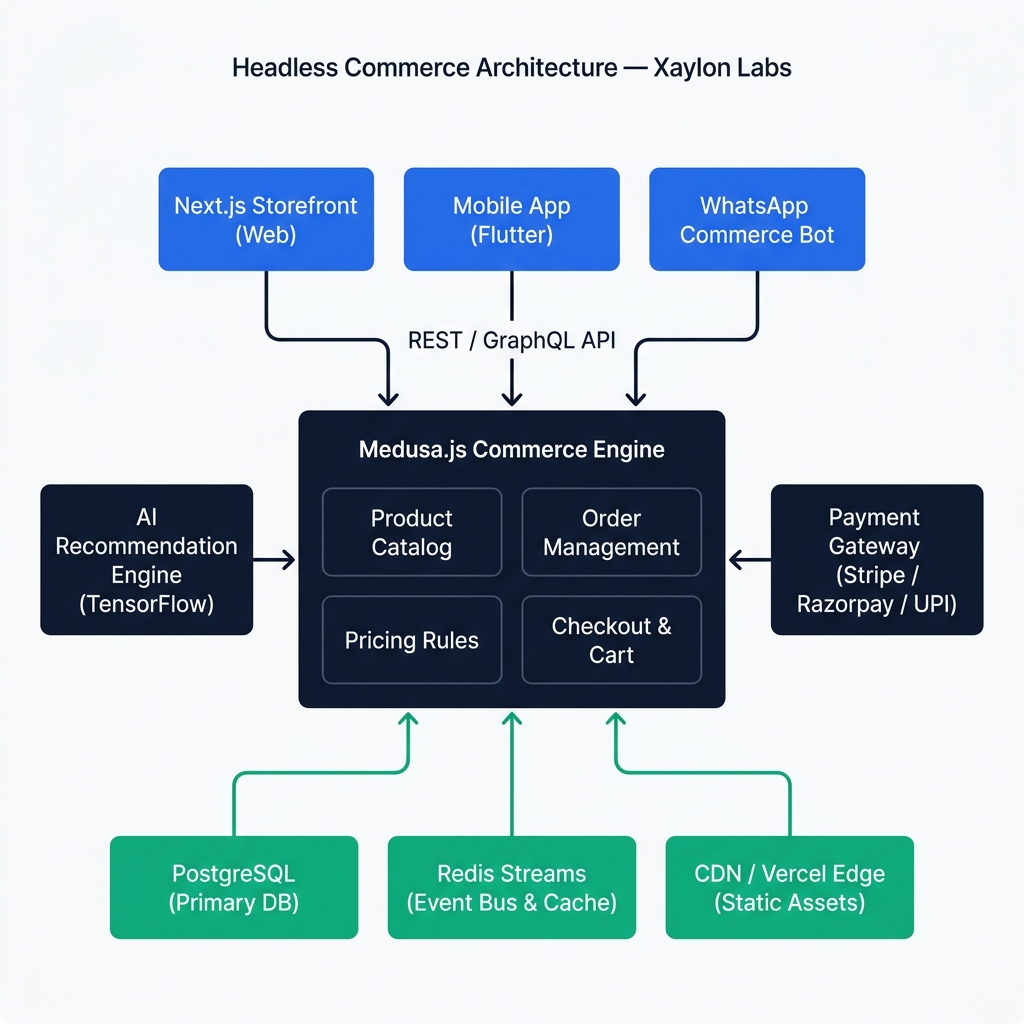
Our approach was not a simple migration — it was a ground-up re-architecture designed for performance, personalization, and operational efficiency. We deployed a three-layer architecture that decoupled the storefront, commerce engine, and data layer.
- Headless Storefront (Next.js + Vercel Edge): We built a server-side rendered Next.js storefront deployed on Vercel's edge network. This delivered sub-150ms Time to First Byte (TTFB) globally and a perfect 100/100 Lighthouse performance score. Product pages are statically generated at build time and revalidated on-demand when inventory changes.
- Commerce Engine (Medusa.js): We replaced Shopify's monolithic backend with Medusa.js, an open-source headless commerce engine that gave the client full ownership of their data, zero per-transaction fees, and unlimited customization of checkout flows, pricing rules, and discount logic.
- AI Recommendation Engine: We deployed a custom machine learning model trained on 18 months of the client's purchase and browsing data. The model powers "Frequently Bought Together," "Because You Viewed," and "Trending in Your City" recommendation blocks — each personalized per-session in real-time.
- Event-Driven Inventory Sync: We replaced the manual CSV workflow with an event-driven architecture using Redis Streams. Every warehouse scan, shipment, and return triggers an immediate inventory update across all sales channels — web, mobile app, and marketplaces — with sub-second latency.
System Architecture: The Three-Layer Decoupled Stack
The diagram below illustrates the headless commerce architecture we deployed. The key design principle is complete decoupling — the frontend storefront, commerce engine, and data infrastructure operate independently and communicate exclusively through REST and GraphQL APIs. This means each layer can be scaled, updated, or replaced without affecting the others.
The Impact: Measurable Outcomes
Conversion rate lift — from 1.8% to 5.7% — driven by AI personalization and sub-200ms page loads.
Faster page loads — from 4.2s to 0.15s TTFB — via edge-first Next.js architecture.
Annual revenue within 14 months of launch — a 9x increase from the original $250k baseline.
Uptime during flash sales handling 100k+ concurrent users with zero order drops.