Industrial IoT & Smart Manufacturing: How a Tier-1 Supplier Saved $4M Annually
From manually tracked inventory to a fully automated IIoT ecosystem. How we integrated 1,200+ machine sensors to eliminate "Inventory Chaos" and deliver predictive maintenance alerts that saved 480+ hours of unplanned downtime annually.

The Operational Reality: 12% Unplanned Downtime & Data Silos
Our client, a leading Tier-1 automotive supplier, was operating across three massive manufacturing plants with hundreds of injection molding machines and assembly lines. Despite their scale, their maintenance protocols were reactive — a machine broke down, the line stopped, and a technician was called.
This "Run-to-Failure" model led to an average of 12% unplanned downtime across the facility. Furthermore, inventory tracking for both raw materials and finished goods was handled via manual scans and periodic physical audits. The result? Frequent line-stop situations because the ERP showed stock that didn't exist on the floor — what they called "Inventory Chaos."
The Challenges
- Reactive Maintenance: No real-time visibility meant maintenance only happened *after* failure, costing an estimated $12,000 per hour of line-stop.
- Disconnected Edge Devices: PLCs (Programmable Logic Controllers) on the floor were isolated. Data existed but was stuck behind proprietary vendor protocols (Siemens, Fanuc, Rockwell) with no central collation.
- Inaccurate Inventory Sync: Manual scanning resulted in a 15% discrepancy between actual floor stock and ERP records, leading to emergency expensive procurement.
- Regulatory & Quality Compliance: Meeting automotive quality standards required precise log-keeping of machine parameters, which was currently being done on paper with high human error rates.
The Solution: An Integrated IIoT Ecosystem
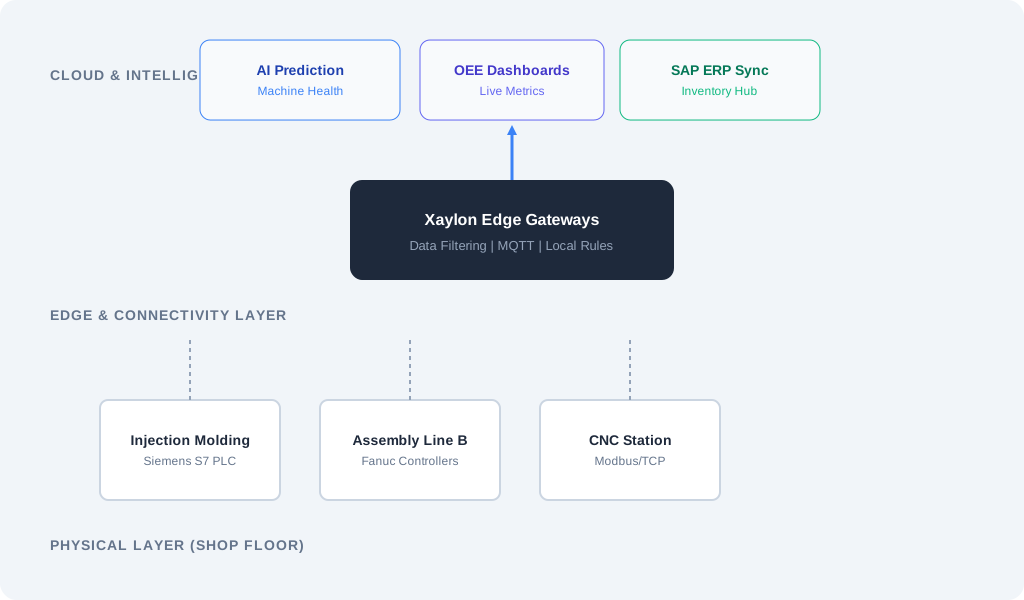
We built a multi-layer Industrial IoT platform that bridged the gap between the shop floor and the corporate ERP. Our architecture leveraged edge-gateways to translate diverse PLC protocols into a unified MQTT data stream for real-time analysis.
- Protocol Agnostic Connectivity (OPC-UA/MQTT): We deployed edge-gateways running custom connectors that could talk to Siemens, Fanuc, and Rockwell PLCs simultaneously, pushing data to an AWS IoT Core backend.
- AI-Driven Predictive Maintenance: We trained ML models on machine vibration, temperature, and current consumption data. The system now predicts "Probability of Failure" 72 hours in advance, triggering automated maintenance tickets before a breakdown occurs.
- Real-time RFID Inventory Tracking: We replaced manual scans with a high-bandwidth RFID gate system at every movement point. Stock updates in the ERP (SAP) happen in sub-second time, ensuring 99.9% inventory accuracy.
- Interoperable Executive Dashboards: A custom real-time dashboard suite provides plant managers with "OEE (Overall Equipment Effectiveness)" metrics, heat maps of downtime causes, and energy consumption per unit produced.
System Architecture: Edge-to-Cloud Flow
The core of the system is the Edge-to-Cloud Bridge. By filtering and processing telemetry data at the edge, we reduced cloud ingestion costs by 60% while maintaining sub-second latency for critical safety alerts.
The Impact: Measurable Operational Transformation
Verified annual operational savings through reduced downtime and optimized inventory holding.
Reduction in unplanned downtime within the first 6 months of IIoT deployment.
Inventory accuracy achieved via automated RFID gates, eliminating manual tracking errors.
Full ROI period - project costs were completely offset by operational savings in just over a year.